Overview
This challenge is part of the ReLearn Workshop at CVPR 2026 in Denver, Colorado. ReLearn studies the relationship between human and machine intelligence and how cognitive and psychological insights can guide the future of AI.
Theory of Mind (ToM)—the ability to infer others' mental states—is a cornerstone of human intelligence, making it an ideal testbed for evaluating how well AI systems can learn social reasoning from human behavior. We propose a challenge that leverages multimodal inputs (videos, textual scene descriptions, and dialogues between agents) to infer an agent's mental states, including goals, beliefs, and beliefs about others' goals. This setup introduces the additional complexity of identifying which modality contributes essential cues for reasoning about unobserved mental states. While humans can accurately perform such reasoning, current models remain far from this level of accuracy.
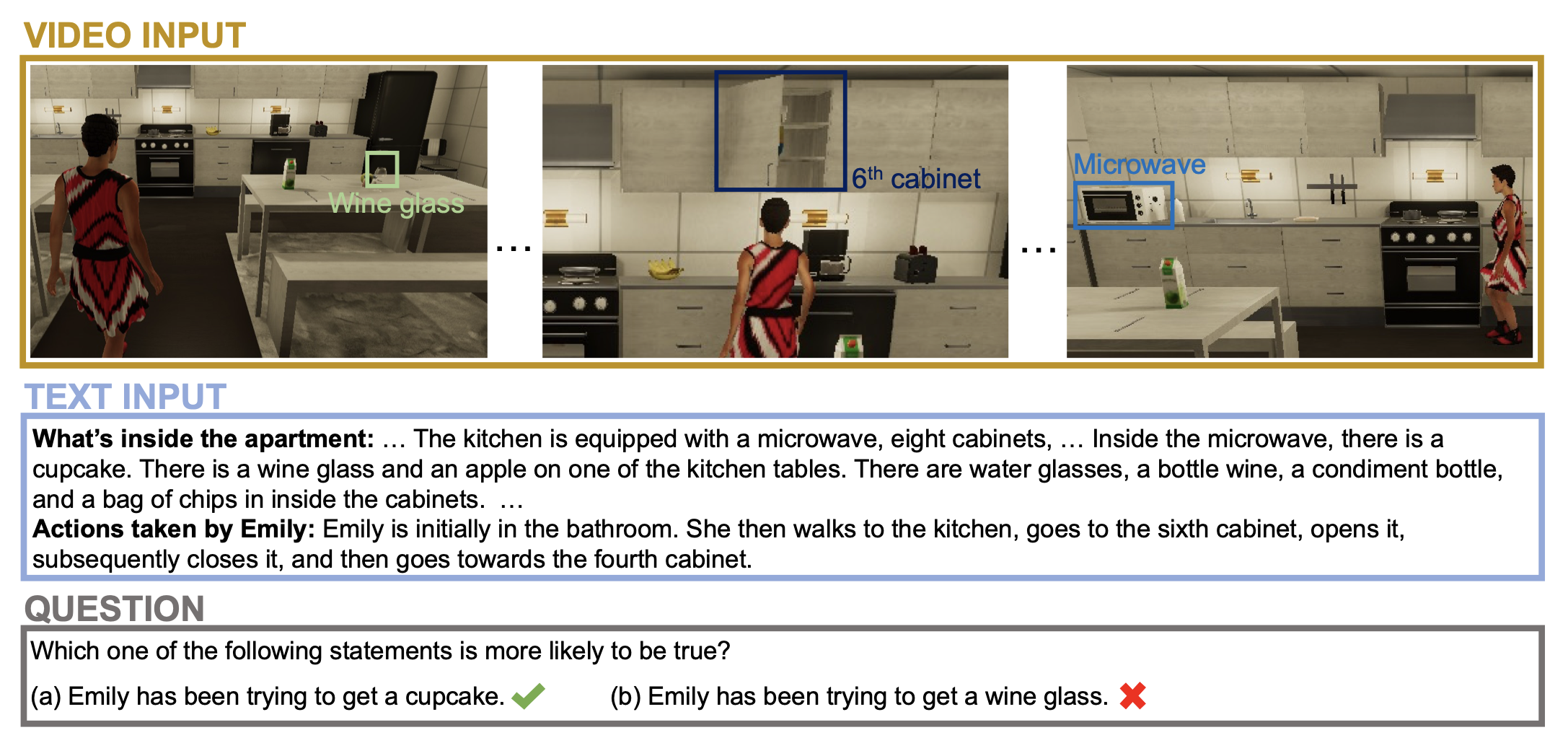
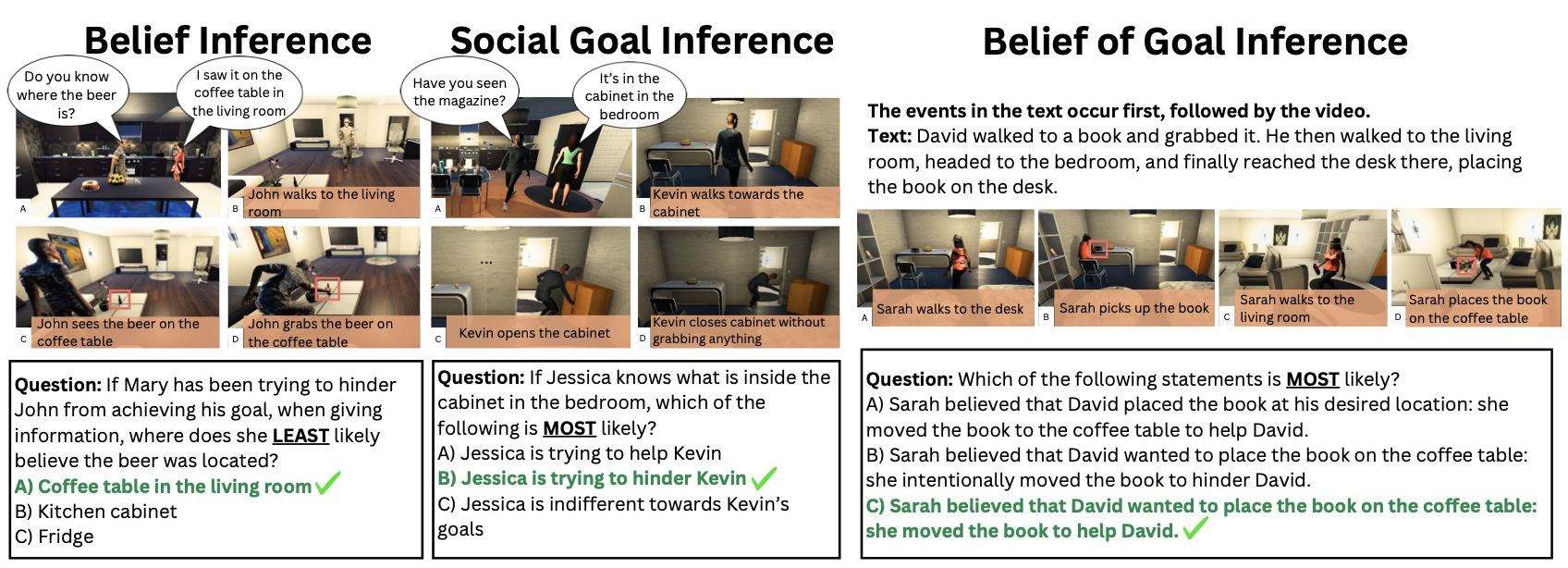
Building on recently released benchmarks, MMToM-QA (ACL'24) and MuMA-ToM (AAAI'25), we will host two tracks in this challenge: 1) reasoning from a single agent's behavior and 2) reasoning from multiple agents' interactions.
Single-Agent Reasoning
Infer goals from video and textual scene descriptions.
Multi-Agent Reasoning
Infer beliefs and social goals from multiple agents' interactions and dialogue.
Timeline
- Registration & submission opens: February 23, 2026
- Submissions due: May 3, 2026
- Final results & winners announced: May 5, 2026
- Winners submit technical report: May 19, 2026
For full workshop details, invited speakers, and call for papers, see the ReLearn workshop page.
Participation
Registration
To participate in the challenge, you must register your team by filling out the form below. Registration is a strict requirement. After you register, you will receive a Team ID—use this ID when submitting your results for Track 1 and Track 2.
Track 1 Single-Agent Reasoning
Dataset
This track follows the MMToM-QA benchmark. You will need to generate answers to the questions in MMToM-QA/Benchmark/questions.json and store the results in the following JSON format for evaluation.
Submission format
Submit a single JSON file (.json).
- One JSON array: one object per question.
- Each object:
question_id(integer) andanswer(string). - Answer must be one of the benchmark options, e.g.
"a"or"b".
Example: [ {"question_id": 1, "answer": "a"}, {"question_id": 2, "answer": "b"}, ... ]
Submit your results
Track 2 Multi-Agent Reasoning
Dataset
This track follows the MuMA-ToM benchmark. You will need to generate answers to the questions in MUMA-TOM-BENCHMARK/questions.json and store the results in the following JSON format for evaluation.
Submission format
Submit a single JSON file (.json).
- One JSON array: one object per question.
- Each object:
scenario_id(integer),question_id(integer, within that scenario), andanswer(string). - Answer must be the option letter, e.g.
"A","B", or"C".
Example: [ {"scenario_id": 1, "question_id": 1, "answer": "B"}, ... ]
Submit your results
Help
General help
Dr. Xi Wang : xi.wang@inf.ethz.ch
Dr. Yen-Ling Kuo : ylkuo@virginia.edu
Submission help
Yan Zhuang : yyx3hd@virginia.edu